Enjoy Intimacies

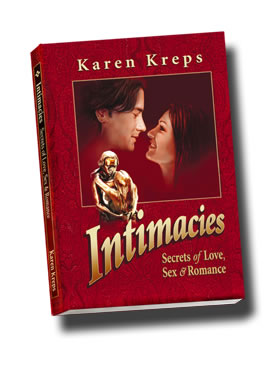
Intimacies: Secrets of Love, Sex & Romance by Karen Kreps

Cover of the book, Intimacies: Secrets of Love, Sex & Romance by Karen Kreps

Buy the book for yourself, someone you love or a friend who could use it.

Since 2002, minds have been opened by Karen Kreps’s insights about love and lovers, shared in monthly columns for The Good Life magazine and hosted the related public conversation group that met monthly at public groups she organizes at BookPeople to discuss these personal topics.   Her book, Intimacies: Secrets of Love, Sex & Romance, contains a collection of her columns and is illustrated with photographs of figurative sculpture by her husband, Arye Shapiro.

Karen is an advocate for giving voice to what needs to be said, even it it breaks a taboo or two. Read her blog below, come to the meeting listed above, and get satisfaction between the covers of her book.

The Intimacies Conversation Group meetings, hosted monthly by Karen Kreps, 2002-Jan 2009, was sponsored by
Good Life Magazine logo.

At our last meeting, on Jan 21, we talked about

“Love in the Recession”

It was our final meeting at BookPeople  after a seven-year run, since our sponsor, The Good Life magazine, has ceased publication.

Watch as this site transforms over the coming weeks to take the Intimacies discussion to new dimensions.

Please tell us what you think of the book, the column or the meetings. Leave a comment below. (If comment form isn’t showing below,  please click on the title of this post and it will appear in the new page.)

My Gift to You–a FREE eBook

Hello. I hope  you show your love boldly. Please accept as my gift to you a copy of my FREE ebook.

To request a copy please use the special-offer form on http://intimacies.weebly.com. All I ask is that you simply answer the one question on that form and let me send you—not a dozen roses, but “A Dozen Choice Intimacies,” a 38-page eBook, a special collection of twelve essays I’ve written on Intimacies. You’re welcome to share them with anyone you like—or anyone you love.

1.     Ditch Mr. Lonely, you deserve a love that’s better
2.     Meeting eye to eye may seen as invitation to romance
3.     Massage can enhance love if you let your heart be touched
4.     Why do people want to have sex? For reasons varied and complex
5.     How to learn to be a lover? Experiment and communicate
6.     Friends with benefits—just the perks without the ties
7.     It’s a shame, shame, shame how we feel shame about sex
8.     Why eat an apple a day, when sex may keep the doctor away?
9.     Overcome complacency, revolutionize your sexual outlook
10.   Whose duty is it to do what when sexual desire dims?
11.   The mysteries of age meet the mysteries of sexuality’
12.   Singles or doubles, it’s good just to be in the game

The first one, “Ditch Mr. Lonely, you deserve a love that’s better,” has never before been published. It was written for the February 2009  issue of the The Good Life magazine, which never made it to press.

To receive this free farewell gift, please tell me: What is your Number One question about relationships?

I will add you to my new email list to keep you posted about future events and Intimacies-related news. Of course, you can opt out at anytime.

Please visit http://intimacies.weebly.com.

Blogging again, here and on AustinPost.org

After a hiatus following the news that my publisher had gone out of business, I’m getting back into blogging about Intimacies. I’ll be cross posting to an exciting new online venue, AustinPost.org. Following is my intro article:

“Why, you’re the Carrie Bradshaw of Austin!” More than a few people said this when I told them that I wrote about “Intimacies.” I was clueless about the heroine of “Sex in the City,” since I didn’t watch much television. Eventually, I caught on. While I didn’t have Carrie’s stunning wardrobe or her lavish lifestyle, I did—for seven years—write a magazine column about love, sex and romance. I also hosted monthly meetings in Austin at BookPeople, where scores of singles and couples met to openly ask about and share tales of intimate experiences normally restricted to the privacy of the bedroom. I published a book, Intimacies: Secrets of Love, Sex & Romance.

So what made me a “sexpert”? As a single gal, I had been around but was not as promiscuous as Carrie’s friend Samantha. As a married woman, I had learned how to make love last. Last week, my husband and I celebrated our seventeenth wedding anniversary. I have experienced earth-moving multi-orgasms, and I knew also how to fake them. I was no different from many women, but I didn’t mind breaking a taboo or two. When it comes to sexual secrets, I have asked–and I have told.

Being the Carrie Bradshaw of Austin could be awkward. My photo was published in each issue of the magazine; I would meet strangers who thought they knew me. Did they think, “Oh, that’s her! I know a lot about her sexual interests!”

I enjoyed having a good excuse to ask anyone, “So, how’s your love life?” And I took notes on hedonistic behavior, seduction techniques, use of pornography, exhibitionism, polyamory and more.

The big turn on, however, isn’t about explicit sexual content. It’s about the more subtle interactions that occur between lovers and would-be lovers: the hide-and-seek, the courtship, caring and commitment—or the lack of it. Underlying all intimacy is communication that connects two entities as one. Connecting with another human being, intimately, is one of the great gifts of life.

Sadly, last January, my publisher suddenly went out of business. It was like losing a lover. But when one relationship ends, it opens the door for new ones. The AustinPost.com is replacing print, and blog posts from my own site, TrueIntimacies.com, will appear here. Share with me your Number One question about relationships, and I will send you a free e-book, A Dozen Choice Intimacies, and I’ll take a crack at offering an answer. In Austin, “Intimacies” thrive.

Baring it All at Hippie Hollow

There’s no finer place to catch a few rays and perfect your line-free tan than Hippie Hollow on Lake Travis.

This bucolic area is a clothing-optional public park in Texas. When I mentioned that I liked going there, a friend asked if she could join me sometime. This was surprising, as she was going on seventy. She’s gone skinny dipping with girlfriends, but has never in her life been any place like a nude beach. Her husband of fifty years and her grown kids applauded her impulse to venture out with me. We packed towels, chairs, lunch and plenty of sunscreen—but no bathing suits—and off we went.

It’s a world away from the bustle of nearby Austin, a haven for those who wish to escape the rigors of modern life in a safe and comfortable nudist atmosphere. Hippie Hollow welcomes visitors from all over the world. The park of one hundred and nine acres features a steep, rocky limestone shoreline and provides some spectacular views of Lake Travis. Clothing optional means just that. You don’t have to take off your clothes. Plenty of people don’t. Only it feels a lot better in the water. And in the breeze. And in the sun.

On weekend afternoons, the rocks will be crowded with people sunning themselves with no inhibition, chatting, reading, snacking, and playing cards. Stroll past the second bathhouse and you’re in the gay neighborhood. Everywhere people are friendly, unusually so. A community has evolved that stays in touch with a forum on www.hippiehollow.com. (You’ll find directions and more information there as well.)

On that site, one denizen stated, “You can set up near others or tucked in a corner if you want to take tentative steps. As for body shape and level of attention, it’s simply not an issue. Folks you meet will be friendly and they’ve seen it all before, and there’s an infinite variety of people sun worshipping, swimming, relaxing and socializing. Just go ahead and get the first time out of the way, and you’ll be hooked.”

In my experience, there’s less of a sexual charge on a nude beach because nothing is hidden. When we wear bikinis it says, “I’ll show you most of me, but there are parts that I won’t show you, are secret.” But attitudes about being naked in public vary as much as the do the bodies on display: Rotund, lanky; with tan lines and without.

To see and appreciate the human form in all its variations is the main attraction, and some are forthright about it. One man, undressed and unnamed, says, “It’s so rare to be able to be naked with other people. I like looking at people. It’s stimulating.”

For some, to be out in nature in one’s birthday suit is only natural. “After any amount of time nude at the Hollow, I am loathe to put my clothes back on to leave,” states Jimbo9, moderator of the HippieHollow.com message board. “I hate it. I wanna be naked all the time, everywhere.”

Others find it a liberating challenge to disrobe. Gene recalls: “I used to think it was bad for a straight guy to go alone to a nude beach because I thought that people would think you were there just to gawk. Not so it seems. I felt so free taking my clothes off for the first time and nobody cared.”

Some worry about running into people they know. The first time we came there, my husband met a guy he used to work with at IBM.

Hippie Hollow used to be owned by the McGregor family and was legally a nude beach because it was on private property. When McGregor died he willed the land to Travis County, provided that it always remains a clothing optional beach. If the county ever tried to close it down, it would lose title to the property. The county makes far too much money on admission fees to do that.

At Hippie Hollow sexual activity is not just rude, it’s illegal. One can get ticketed, banned from the park, arrested or any combination of all three. Cameras are allowed, but it is a crime to take pictures without permission and for sexual gratification. This should catch a guy sitting concealed in the bushes with a telephoto lens, but should not affect couples or small groups of people openly and knowingly taking pictures of each other.

My friend was delighted by her first experience. She said, “It’s so freeing to be able to go in the water without anything on. It feels great to take a walk wearing nothing but a sarong and nothing underneath. I was glad you suggested I bring a sarong. They’re perfect when you want to cover up without effort.”

She said she’d have come much sooner, but she couldn’t find anyone with whom to go.

Jimbo9 states, “Hippie Hollow is perfect for showing up alone. After one gets comfortable with being a single party, then one begins meeting people. Meeting people in order to go to the Hollow is much more difficult.”

On our weekday morning visit, my friend and I found ourselves almost the only women there. When we showed any receptivity, men were quick to come over and chat. All left when we wished them a good day and said goodbye.

A couple of creeps made pests of themselves by walking by us repeatedly and too often saying hello. Pathetic! We’d have had a better time with more mixed company. Creeps who go there only to gawk can be real deterrents, but my friend laughed when she saw the lineup of boats motoring just beyond the buoys that rope off a swimming area. She said, “I hope they’re enjoying themselves half as much as we are.”

How Teens Self Savvy–Summary of Our Panel

Omar L Gallaga

Omar L Gallaga

Omar Gallaga is the technology columnist for the Austin American-Statesman and National Public Radio. He wrote a big article about people who self publish last Easter, which featured me and my book.  Now he’s blogged about the Core Conversation I hosted with Karen Rayne at SXSW. Catch his drift on his blog at austin360.com

.

Sexerati Interviews Us about Sex Ed Online

Here at SXSW09 Interactive, Melisssa Giri interviewed Karen Rayne and myself about the Core Conversation  we’ll be hosting 5 pm in room 19B at the Austin Convention Center.

Here’s a bit of what I said to Melissa: “The Internet is creating a paradigm shift in traditional sex ed. It throws open the window on sexuality and intimacy, democratizing access to new levels of understanding and skill. Just a few generations ago, the ancient teachings of Tantra Yoga were secrets shared only with select initiates. Now all one have to do is Google it to learn. The Internet has spread new Sex Positive concepts and provided in-depth discussions of polyamory. We are no longer limited to only knowing what Mommy and Daddy knew and told us about the birds and the bees or books we could find and read in private. We can learn about how other people make love, broaden our experience from the safety of our homes without risk, and adapt as much as we please in our personal lives.”

Read more at Melissa’s blog.

See the links we suggest on the topic of Sex Ed Online.

Ditch Mr. Lonely, you deserve a love that’s better

1080946 sad silhouette crop Ditch Mr. Lonely, you deserve a love that’s better

by Karen Kreps

Does the symbol of Cupid’s arrow strike a chord in you? Do you associate love and romance with pain and longing? Too many of us do.

I’ll bet you’ve been dating Mr. Lonely. You know whom I’m talking about: the guy who occupies your thoughts but who always lets you down on some level and leaves you feeling lonely. If you’re counting on him for chocolates, flowers and great sex on Valentine’s Day, you’ll be in for disappointment. Yet you keep on hoping that, this year, things will be different, that he’ll finally get the message you’ve been sending him and respond appropriately.

Ditch him! Don’t waste another precious night pampering the fantasy that he’s good for you. Mr. Lonely is the anti-Valentine.

That guy can’t be trusted. He sleeps with everyone. I have gone to bed with him on more than one occasion, and I haven’t met a gal who hasn’t at least flirted with him. That dirty cur wouldn’t be sniffing around at your panties if you weren’t doing something to encourage him. Stop singing those torch songs. What do you find attractive about him? That he makes you feel? Don’t you know that feeling emotional pain and rejection only has one lasting effect: It numbs you.

How did we ever fall for him? The causes could be many.

Blame it on some old beau who long ago left you but for whom you never stopped pining. It may even trace back to a girl’s unrequited love for her father. We associate our attachment to an unavailable guy with romance and obsess about him with the loyalty that deservedly belongs to a man who can handle commitment. Instead, our emotional attachment to Mr. Lonely may trap us in the past. We strongly identify with the rejection we experienced and we ruminate on the story, replaying it like an old record. We expect the next guy we meet to be no different from the one who did us wrong. Listening to these old albums may cause us to be remote and miss the experience of true love from someone really nice, who isn’t the least bit like him.

This foible of human behavior is described by Eckhart Tolle in one of his bestselling books, A New Earth: Awakening to Your Life’s Purpose, as the function of the pain-body: “The remnants of pain left behind by every strong negative emotion that is not fully faced, accepted, and then let go of join together to form an energy field that lives in the very cells of your body.”

Women aren’t the only victims of Mr. Lonely. He has a female counterpart. Ms. Lonely can be a real bitch. She is a narcissist, all wrapped up with her self. Should she pay any attention to you, it’s to cast judgment. She’ll cut you down to size and snub you at a party because you not rich enough, strong enough or sufficiently handsome to merit her affection. Tolle writes that the pain-body feeds on negativity, “The pain-body that is ready to feed can use the most insignificant event as a trigger, something somebody says or does, or even a thought.”

Mr. and Ms. Lonely usually haunt singles, but they may also sneak into the marital bed, summoned there by your pain-body. You may have married your Dream Lover only to awake one morning next to someone who doesn’t understand you and who refuses to meet your expectations, leaving you to feel lonely even in your marriage.

John T. Cacioppo and William Patrick demonstrate in Loneliness: Human Nature and the Need for Social Connection how loneliness creates a feedback loop that reinforces social anxiety, fear and other negative feelings. By learning more about what underlies this experience, then learning to reframe their response, lonely individuals can reverse the feedback loop, overcome fear and find ways to reconnect.

So what can we do to slam the door on Mr. Lonely and to open our hearts and arms to someone more deserving of our love? I, for one, would start by giving myself the respect and attention I wanted but, in times past, didn’t get from that jerk. I can set an example for others by being gentle and sweet with myself. Then I can think about how to share the warm fuzzies with someone who will appreciate them.

When I feel solid in myself, positive about whom I am and what I can accomplish, I know I’m more attractive to others. I’ll draw others who see me as I see myself and the feedback loop becomes much more rewarding.

Having positive experiences about myself and others, I may even go on a rampage of appreciation and express to my partner the very kind of thoughts Mr. Lonely never voiced: “You are the greatest friend. Your touch fills me with delight. Your stories make me smile and I laugh when I’m with you. You do so many thoughtful things to help me out. I feel secure in your company and want to spend more time there. I trust you, and you can count on me to be there for you when you need a friend.”

In her humorous and life-affirming book, Excuse Me, Your Life is Waiting: the astonishing power of feelings, Lynn Grabhorn writes that we can free ourselves from the chain of pain if we stop trying to fix what we see as wrong in others. “If we can find something—anything—to appreciate about them, and plant the seeds of potential new growth about them with our positive vibrations, we open up a chance for change.”

We’ll be in a SXSW Interactive Core Conversation

sxsw2009ia Well be in a  SXSW Interactive Core ConversationI’m delighted to announce that I’ve been invited to host a Core Conversation at the SXSW Interactive Festival in Austin, TX. It will occur Sunday,  March 15, 5 pm in Rm 19B at the Austin Convention Center.   The topic will be “Sex Ed Online: How Teens Self Savvy,” and joining me in presenting this hour-long conversation will be Karen Rayne, PhD. She is an expert in adolescent development and education who teaches workshops and counsels parents and teens on human sexuality.

17564 32 Well be in a  SXSW Interactive Core Conversation

Some of the questions I’ll be asking Karen:

1. What do teens want to know about sex?
2. How do they use the Internet to find answers?
3. Which social media tools provide the best sexual education?
4. What positive or negative impact can the Web have on teen sexuality?
5. At what ages should online use by children and teens be monitored?
6. Are parents abdicating their roles as sex educators to the Internet?
7. Does online info encourage or discourage sexual experimentation by teens?
8. What role does the Internet play in educating youth about sex?
9. Can the government regulate online sex education and should it?
10. Can online sex info be trusted for accuracy?

Thanks to everyone who commented on the SXSW panel picker in support of my proposal. They  received more than 1300 panel proposals for the 2009 South by Southwest (SXSW) Interactive Festival. Most of these ideas are extremely impressive in their analysis of current (and future!) issues in the new media landscape. In lieu of a panel, I was invited to host a more intimate Core Conversation. This will have a format much like the monthly meetings I host at BookPeople. At a SXSW Core Conversation, there’ll be 30-50 people seated and standing around a round table with one or two presenters. I’m excited that Karen Rayne and I will have the opportunity to talk on this personal topic with the  web developers and digital creatives who attend this conference.

Now I’m very challenged to learn more about the subject. Please share your thoughts and insights into how the Web is changing how and what adolecents know about sex and sexuality.

Why do people want to have sex? For reasons varied and complex

What motivates us to mate?

by Karen Kreps

I didn’t really feel like having sex the other day, but I did anyway. My motivation wasn’t very clear. I had some free time. There was an opportunity to join my husband while he was taking a siesta. I assumed correctly that he’d welcome my initiative, and I said to myself, “Why not?” I thought it would relax me and help me get out of my head. It did.

The reasons we choose to have sex vary from person to person and from time to time. People do it for serious life-affirming reasons, for frivolous debauchery and everything in between.

“Historically, the reasons people have sex have been assumed to be few in number and simple in nature—to reproduce, to experience pleasure or to relieve sexual tension.” So wrote a couple of professors from the University of Texas at Austin. Cindy Meston and David Buss, both PhDs in the Department of Psychology, have published a thorough taxonomy of sexual motivation in the Archives of Sexual Behavior after conducting a scientific study of why people have sex—an extremely important, but surprisingly little-studied topic.

Research in the nineteen-seventies, -eighties and -nineties showed that people had sex for reasons that were varied and psychologically complex. These included a desire for pure pleasure, to express emotional closeness, to please a partner and to make a conquest. Yet most of the reasons documented in those decades, implicitly assumed the context of an ongoing romantic relationship or long-term mate. Humans, however, have a menu of mating strategies, including long-term, short-term and extra curricular mating. There might be reasons for having sex with a casual sex partner such as the desire to experience sexual variety or seeking to improve one’s sexual skills. Sex could be exchanged for favors, special privileges and a preferred job or indeed for any resource.

Sex might be used to reward a partner or as a favor in exchange for something the partner has done. Or sex might be used to retaliate against a partner for some perceived wrongdoing. Also, sex might be used to intensify the relationship, escalate the level of commitment within the relationship or turn a relationship from short- to long-term. Women, in particular, were thought to engage in sexual intercourse for emotional closeness, bonding, commitment, love, affection, acceptance, tolerance and closeness.

In their recent study, Meston and Buss surveyed more than four hundred men and women, ranging in age from seventeen to fifty-two, who responded to the query: ‘‘Please list all the reasons you can think of why you, or someone you have known, has engaged in sexual intercourse in the past.’’ The more than seven hundred answers collected resulted in two hundred thirty-seven distinct reasons.

Once they came up with that long list, Meston and Buss asked more than fifteen hundred college students, in exchange for psychology class credits, to rank the reasons in terms of how they applied to their experiences. Keep in mind that these results reveal the behavior of those who are of an age when, Meston conceded, “Hormones run rampant.” She predicted significant differences when older people are studied.

The research found similar reasons for why these young adults got intimate, and the Number One reason was simply: “I was attracted to the person.” While the primary reason involved lust, rather than amour, expressing love and showing affection still were in the top ten for both men and women.

Gender differences were negligible. Twenty of the top twenty-five reasons given were the same for males and females. “Men were more likely to be opportunistic towards having sex,” Meston said. “So, if sex was…available, they would jump on it—somewhat more so than women. Women were more likely to have sex because they felt they needed to please their partner.” Men, the study revealed, were more apt than women to have sex to get things like a promotion, a raise or a favor. Guys were much more likely than gals to say they’d had sex to “boost my social status” or because the partner was famous or “out of my league.”

The study Meston and Buss completed inspired New York Times science writer John Tierney to provide an on-line forum where the public could add their ideas to the list of reasons to have sex. In just a few days, he got hundreds of responses, which lead the UT researchers to put an additional forty reasons on their list.
Reading the many tawdry reasons why others have sex, I felt more inclined to forgive my own past foibles.

The reasons I found scariest involved revenge: “I wanted to give someone else a sexually transmitted disease (e.g., herpes, AIDS),” “I wanted to get rid of aggression” and ‘‘I thought it would help ‘trap’ a new partner.”
The most inspiring reasons involved celebration: “Because life is short (and a hundred years from now we will all be dust),” “To recover or reaffirm life after the loss of (a) loved one” and “I wanted to become one with another person.”

While we may wish to keep to ourselves the rationalizations for our behavior, the act of reasoning itself has value. By delving into our own feelings, getting honest with ourselves about why we get it on, we’ll gain greater personal understanding of and appreciation for our own sexual natures.

It’s a shame, shame, shame how we feel shame about sex

What causes us to lower our eyes in shame?

What causes us to lower our eyes in shame?

by Karen Kreps

Admit it. You and I have all experienced it, and we enjoyed it—though we’re loath to tell anyone exactly what we did. We felt heat emerge from within our bodies, as a flush turned skin red and self-consciousness became acute: We wallowed in our private sense of sexual shame.

Ever since Adam and Eve got expelled from the Garden of Eden (the Hebrew word for which, by the way, means, “pleasure”), humans have been ashamed of their nakedness. Sure, we’ve been through the Sexual Revolution and now many people have declared themselves “sex positive” (a movement promoting open sexuality with few limits, in contrast to sex-negativity, which adherents identify as the dominant view of sex in Western culture). But shame—either suffered by the submissive or inflicted and enjoyed vicariously by the dominant—still permeates the sexual experience.

There’s an undercurrent, if not an emphasis, on bondage and sadomasochism (BDSM) in erotica, pornography and adult entertainment. The master-slave dynamic is acted out to stimulate our imaginations. For some, it is a turnoff. For others—such as consumers who support the ten billion dollars-a-year pornography industry—it is arousing.

Most adults won’t talk about sex. For some, it’s a matter of discretion. For many, sexual issues are seen as “dirty” and immoral, even in this age of supposed sexual enlightenment.
Why is a natural act, even non-kinky sex, a source of shame?

Children are taught to feel shame from an early age. When used properly, it is a useful self-regulating mechanism for behavior. Sadly, it often causes the shamed one to pull back, physically and emotionally, afraid of being exposed or seen as being bad.

Feelings of shame may also be the result of sex abuse or early childhood stimulation, which could not be resolved—unrequited Oedipal longings. But even in normal, age-appropriate sex play, children may be shamed and told they are bad and wrong. When parents are embarrassed by their children’s sexual behavior, they pass their misgivings about sex to their offspring. As a result, for example, we begin to feel guilty about masturbation, the most basic self-care and self-pleasuring.

We’re fooling ourselves if we think we could totally free ourselves from these feelings of shame. So many religions and customs have linked sex with guilt that few of us are entirely unaffected. Over centuries, the Judeo-Christian ethic has ingrained into our psyches the belief that sex is synonymous with sin. Churches have used shame as the guiding force to redirect young peoples’ sexual impulse. Puritanical teachings say that life is about suffering and the hedonism of pleasure is to be shunned. It’s programmed into us. Yet we enjoy intimacy and making love. So when we do things that support that, we feel a sense of shame.

Some men have a Madonna-whore complex. They want to be mated with a pure virgin, but sex without guilt doesn’t to it for them, and they lust after the shame of a prostitute.

We pride ourselves on having evolved out of the cave to a highly sophisticated social structure where sexual impulse is restrained by intellect. Our fear of being discovered spares us from doing things we would later regret.

Guilt emerges when we revert to our animal behavior. We’re ashamed about appearing selfish in our desires or about having lost control of ourselves. Orgasm becomes taboo, experienced only in private and rarely discussed. We feel inhibited by something. Could it be the fear of being visible, disarmed at the deepest levels?

Sexual shame is rampant in our culture. We objectify each other sexually, and then we feel shamed for having done so. Thinking of someone as a sex object instead of as a human is a way of depersonalizing the experience, of toning down the intensity. And we can even recognize this self-imposed limitation and feel ashamed for indulging in it. Then we eroticize shame itself. Its “forbidden” status hooks us into an addictive cycle made even stronger by shame.

Although stories of sexual shame now fill tell-it-all TV talk shows, the pages of popular magazines and the plots of soap operas, few people will ever talk about or admit to their own feelings of shame. If one or both partners are too shy, embarrassed or ashamed to talk about sex and any shame they may associate with it, they’ll miss the exploration and risk-taking required for good, lasting sex with a long-term partner.

“There are two ways to absolve ourselves of shame,” states psychologist and sexologist Joy Davidson. “One is to speak of it, share it, expose it to the light and watch it burn away. The other is to use it, to eroticize it. Fantasy allows us to utilize shame in extraordinarily creative ways. If you allow yourself this privilege, you triumph over shame.”

Tantra is an Eastern tradition that teaches us to reframe how we see sex, to celebrate it as divine, not a shame. It views sexuality as a path on by which we may be guided out of the illusion of being incomplete and separate to an understanding of our intrinsic wholeness and connection.

Before we evolve to that exalted level of consciousness, we have some issues to work out. Perhaps it’s not a shame that we experience shame, for it compels us to self-examine and to better understand what triggers our response. Do enough of that, and lovemaking is bound to be something to be—not ashamed of—but proud about.

Between these covers, find the secrets to great relationships!


Buy the book now and learn about love.

Cover of the book, http://trueintimacies.com/i/3D_book_copy.jpg

Get blog updates via email


Enter your email address:

Delivered by FeedBurner


The Intimacies Group Meetings

For seven years, until the magazine folded January 2009, Karen wrote the "Intimacies" column for The Good Life magazine and hosted monthly meetings where 20-40 adults gathered to talk about Intimacies at BookPeople in Austin, TX. Learn about the topics and guests she's entertained and find out about related and upcoming events.